Wednesday, May 20, 2009

Only in Hong Kong


Today in Hong Kong I noticed something that I think I would only see in Asia's International Financial City:

Of course one thing that you can only find in Hong Kong (mostly) is the bamboo scaffolding which seems to be everywhere here, but only used sparingly in other Chinese cities:


Thursday, May 7, 2009

More Photos of Old Malacca


Malacca is a curious juxtaposition of Chinese, Dutch, and Malay. Malacca has a quaint old town with Chinese, Portuguese, and Dutch shop houses, and there is a Hindu temple, a mosque, and the oldest Chinese temple in SE Asia (maybe) all on the same street. Today I learned about the difficulties of preserving some of these old places. I visited a conservation project that is trying to renovate a Dutch shophouse using original materials, which includes lime. Evidently lime is porous and allows excess moisture to escape, while cement and paint seal it in and ruin the walls from the inside. The house next door has used cement so salt deposits leach out onto the conservation house's walls.


Down the street is the home of an obviously wealthy (über rich) Chinese family of the 1930's. Huge and gilt, the place is a museum of museum-quality furniture, house wares, embroidery, and house décor carvings. Down to the underside of the stairs and the railings in the stairs, everything is detailed and touched with gold. Gaudy, but beautiful.

Tuesday, May 5, 2009

Old Malacca


Today in Malacca I had their famous chicken rice balls. These are balls of rice full of chicken flavor (must be cooked in chicken stock). Served with cut up juicy chicken, you've got yourself a yummy meal for 2 bucks!

Other delicacies here include the Nyonya food (Nyonya is like the Singaporean Peranakan: people of mixed parentage: "foreigners"- usually Chinese or Indian men marrying Malay women several generations ago ((see Singapore People)) ). Spicy Otak-otak fish mush (yummy), chicken soup with a dark tangy sweet broth, nyonya laksa (curry like noodles), and I don't know what else! More things definitely but hard to describe.

Malaysia is full of street food and Malacca has its own. But most places seem to close early. We walked by a riverside cafe that seemed like the perfect place to sit and have a drink and watch the sky turn colors. But they were closing up at 6 pm! Maybe of was because it was Tuesday- the day many places close shop due to tourists going home on Mondays.


Malacca was declared a UNESCO heritage site last year and evhdently the tourists descend on the weekends. We did see a Chinese tour group all taking pictures with a group of Muslim girls in their veils.


Saturday, April 25, 2009

Faceless Beauty

Today in Hong Kong I visited the new Sephora store. It is really big but has pretty much the same things we have in the US stores. Except they have this interesting product that removes more than make up:


Friday, April 17, 2009

Macau's Money Malady


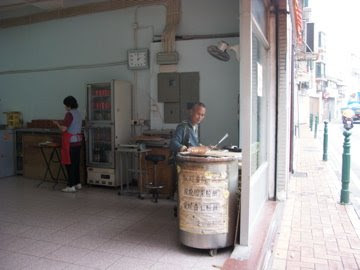
Today in Macau I am eating a French crepe in a little cafe with Chinese art deco trappings in the village of Taipa. Crepe and croissant not bad!
This place was actually recommended to me by an American gondolier last time I was in Macau - September 2007. It's called Cafe Cheri and it is a nice respite from the casino fare and is right around the corner from the famous Pork Chop Bun restaurant. And sure enough, today the line to pick up a pork chop bun is down the street- 75 people long at least!

Taipa is still sleepy and quaint, although there is a McCafe and a Kholer store and there are a few tourists walking around despite the drizzle. That's good because the Macau local economy needs tourists to spend money in local places, not just the Vegas transplants.

Actually, what with the financial crisis and new restrictions on mainlanders coming to Macau, the Venetian was relatively empty compared to the frenetic swarming of gamblers and their families of the hey-day of when it first opened: gamblers, gawkers, grannies and kids...

Now they have put up barriers and built new hallways so the non gamblers aren't tempted to squat on the floor and watch the gamblers. They put up a curtain around the lounge with live music so the gawkers don't take all the seats without buying a drink. And instead of a gold rope to keep out the kids from the gambling area, they have a line of yellow clad security guards.

The taxi driver said that now they only get business on the weekends. The mainlanders come in busses and the Hong Kongers are feeling the pain of the financial crunch. All construction has stopped on the second phase of the Cotai Strip (or whatever phase they are in) and hulls of unfinished buildings stand with their glass and steel exoskeleton done, but with no guts.
Sunday, December 21, 2008

Mekong Market


TODAY in Vietnam I watched the locals do their grocery shopping from their boats. This is the largest floating market in Vietnam and it is not for the housewives but wholesale. Boats laden with hundreds of melons trade with the banana sellers while smart entrepreneurs snake their way in between the large house boats with snacks and drinks.

Everything is interesting in this market: the boats where families live, eat, bathe; the long spears that have the proprietor's wares on display to declare what it is he sells; the small boats serving juice, waffles, or other snacks; the glimpses of life on these "houseboats" where mothers feed their babies and young men steer with their feet.


Saturday, December 20, 2008

The Muddy Mekong


TODAY in Vietnam I watched fishermen and families ply the mighty (muddy) Mekong river looking for edibles amongst the floating plants of the Mekong Delta. This is Chau Doc- the mouth of the Mekong River. Just up a ways is the border with Cambodia and just down a ways is the largest floating market in Vietnam.

I took a river boat down the Mekong, past the market, through the brown swirls of the river that is so often a part of all those Vietnam War movies. Small houses on stilts with fields in their backyards line this huge river. This river starts in China and flows through 5 countries, irrigating, feeding, and supporting the life along its banks.